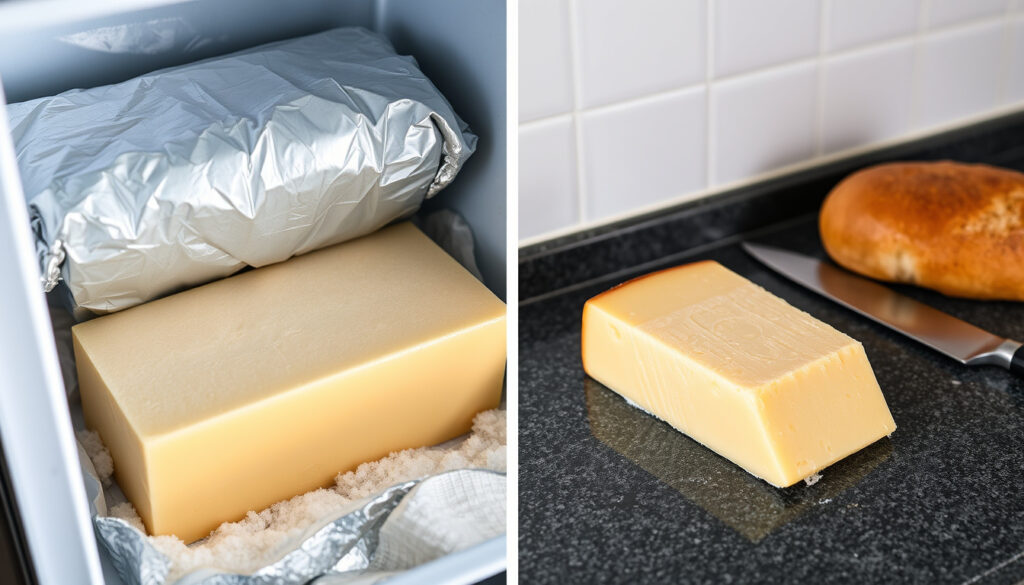
Can You Freeze Cheese? A Practical Guide to Freezing and Thawing
Half a block of cheddar and a freezer door — a kitchen standoff that has a science-backed answer. Whether your cheese survives freezing depends on moisture content, fat structure, and how you wrap it before the chill sets in.
Maximum freezer storage: 6 months ·
Ideal cheeses for freezing: Cheddar, Parmesan, Gouda, Emmental ·
Cheeses to avoid freezing: Brie, Camembert, fresh mozzarella ·
Key wrapping method: Airtight plastic wrap + foil + freezer bag
Quick snapshot
- Hard cheeses freeze well for up to 6 months without significant flavor loss (Academy of Cheese, cheese education body)
- Soft high-moisture cheeses become grainy and watery after freezing (Glad, food storage brand)
- Airtight wrapping prevents freezer burn (Academy of Cheese, cheese education body)
- Whether freezing affects probiotic content of aged cheeses
- Optimal freezing time for very high-fat cheeses like triple-cream Brie
- Hard cheeses: up to 6 months; semi-hard: 3–4 months; soft cheeses: 1–2 months (Epicure Foods Corp, food industry resource)
- Pre-shredded cheeses: 12 months to 2 years (Organic Valley, organic dairy co-op)
- Thaw in refrigerator and use within a few days (Glad, food storage brand)
- Best used in cooked dishes like sauces and pizzas (Academy of Cheese, cheese education body)
- Vacuum-sealing extends shelf life (Epicure Foods Corp, food industry resource)
Five key facts every home cook should know before freezing cheese.
| Label | Value |
|---|---|
| Maximum storage time | 6 months (hard cheeses) |
| Best cheese for freezing | Parmesan, Cheddar, Gouda |
| Worst cheese for freezing | Fresh mozzarella, Brie |
| Freezing method | Wrap in plastic + foil, then freeze bag |
| Thawing recommendation | Refrigerator overnight |
What this means: The difference between a successful freezer batch and a crumbly mess comes down to one factor: moisture. Hard, low-moisture cheeses keep their structure; soft, high-moisture varieties fall apart.
Can You Freeze Cheese?
Yes — but only certain types. Hard and semi-hard cheeses like Cheddar, Gouda, Emmental, and Parmesan freeze very well when wrapped tightly and stored in airtight conditions, according to Glad, food storage brand. The key is blocking air, which causes freezer burn and texture degradation.
How to freeze cheese step by step
- Cut cheese into portions no larger than 1 pound (450 g) for even freezing.
- Wrap each portion tightly in plastic wrap, pressing out all air pockets.
- Wrap again in aluminum foil for a second moisture barrier.
- Place wrapped cheese in a freezer-safe zip-top bag or vacuum-seal bag. Epicure Foods Corp, food industry resource calls vacuum-sealing the “gold standard” method.
- Label with cheese type and date; use within recommended window.
Best wrapping methods
- Plastic wrap + foil + freezer bag — best for home freezers without a vacuum sealer (Academy of Cheese, cheese education body).
- Vacuum-sealing — removes all air, extending freezer life and preserving texture longer (Epicure Foods Corp, food industry resource).
- Freezer paper — acceptable but less effective than foil at preventing freezer burn.
Thawing techniques
- Transfer frozen cheese to the refrigerator and thaw for 8–12 hours (overnight).
- Use thawed cheese within 3–5 days for best quality (Glad, food storage brand).
- Thawed cheese works best in cooked dishes — sauces, casseroles, pizzas — where texture changes are less noticeable.
The trade-off: Even perfectly wrapped cheese loses some of its original creaminess. That’s fine for melting, but not for a cheese board.
Bottom line for home cooks: Freezing hard cheeses is a reliable storage hack when wrapped airtight, but expect textural compromise. Use frozen cheese within 6 months for cooked applications.
What Cheeses Should Not Be Frozen?
Soft, high-moisture cheeses suffer the most damage from freezing. The ice crystals that form inside disrupt the protein network, leading to a watery, grainy, or rubbery texture when thawed, as Glad, food storage brand explains.
Soft ripened cheeses
- Brie and Camembert lose their creamy interior and become unpleasantly grainy after freezing (Glad, food storage brand).
- Triple-cream varieties soften but develop a watery weep upon thaw.
Fresh cheeses
- Ricotta, cottage cheese, and fresh mozzarella (packed in water) separate into curds and whey — irreversible texture damage (Organic Valley, organic dairy co-op).
- Feta becomes crumbly and loses its brine-fed tang.
Processed cheeses
- Processed cheese slices and spreads may become watery and rubbery after freezing due to emulsifier breakdown.
- Cream cheese can be frozen but turns crumbly; best reserved for baking, not spreading.
Why this matters: Freezing is a one-way street for moisture-rich cheeses. The texture you lose can’t be recovered, so it’s better to buy these fresh and use them within a week.
Is Cheese Still Good If You Freeze It?
Yes, cheese remains safe to eat after freezing — bacteria do not grow at freezer temperatures. The bigger question is whether it still tastes and feels right. According to Academy of Cheese, cheese education body, flavor is largely preserved in hard cheeses, but texture always changes: hard cheeses turn more crumbly, soft cheeses become watery and grainy.
Does freezing affect flavor?
- For hard cheeses like Parmesan and aged Cheddar, flavor loss is minimal for up to 6 months (Epicure Foods Corp, food industry resource).
- For semi-hard cheeses like Gouda and Emmental, subtle flavor nuances may dull slightly after 4 months.
- Soft and fresh cheeses often develop off-flavors from moisture separation and oxidation.
Does freezing affect texture?
- Ice crystals puncture cheese’s protein matrix, releasing moisture upon thawing (Gardners Wisconsin Cheese, specialty cheesemonger notes ideal humidity 80–90% to maintain structure, something freezer air can’t provide).
- Grated cheese freezes and thaws with near-minimal texture loss, making it ideal for cooking (Organic Valley, organic dairy co-op reports pre-shredded cheeses keep for 12 months to two years with little change in meltability).
The catch: If you plan to eat cheese raw — on a sandwich or a cheese plate — freezing is not your friend. If you’re cooking it, frozen cheese is perfectly adequate.
What Cheeses Are Ruined by Freezing?
Some cheeses simply don’t survive the freezer. The common thread: high moisture content. When water freezes and expands, it physically breaks down the cheese’s structure.
Examples of cheeses that crumble after freezing
- Brie and Camembert: become grainy, watery, and lose their velvety texture (Glad, food storage brand).
- Fresh mozzarella: turns rubbery and tough, especially if frozen in water.
- Ricotta and cottage cheese: separate completely into liquid and solids.
Why moisture content matters
- Cheeses with over 50% moisture content (e.g., fresh mozzarella, ricotta, Brie) are most vulnerable.
- Blue cheeses (Gorgonzola, Stilton, Roquefort) become more crumbly and less creamy after freezing — still usable in sauces but not as a standalone slice (Organic Valley, organic dairy co-op includes blue in the semi-soft category that freezes “fairly well” for cooking).
The pattern: The higher the moisture, the worse the freeze. Low-moisture hard cheeses (Parmesan, aged Cheddar) are the safest bet.
How Long Can You Freeze Cheese?
Freezer storage time depends on cheese type and packaging. Academy of Cheese, cheese education body states cheese can be frozen for up to six months safely, but texture and flavor degrade beyond that.
Maximum storage times for different cheeses
- Hard cheeses (Parmesan, aged Cheddar): up to 6 months (Epicure Foods Corp, food industry resource recommends 2–3 months for best texture).
- Semi-hard cheeses (Gouda, Emmental, Edam): 3–4 months.
- Soft cheeses (Brie, Camembert): 1–2 months if at all; quality drops sharply.
- Shredded or grated cheese: 12 months to 2 years in airtight packaging (Organic Valley, organic dairy co-op).
Signs of freezer burn
- Dry white or grayish patches on the surface.
- Cheese is still safe but texture becomes leathery or chalky.
- Trim burn spots before using; the rest remains usable.
What this means: Label every package with a date and type. After 6 months, hard cheeses are still safe but won’t taste as good. For best results, aim to use frozen cheese within 2–3 months.
Four cheese categories, one pattern: texture loss is inevitable, but cooking hides it.
| Cheese Type | Freezeability | Max Storage | Texture After Thawing |
|---|---|---|---|
| Hard (Parmesan, aged Cheddar) | Excellent | 6 months | Crumbly but flavorful |
| Semi-hard (Gouda, Emmental) | Good | 3–4 months | Slightly mealy, melts well |
| Soft (Brie, Camembert) | Poor | 1–2 months | Watery, grainy, separates |
| Blue (Gorgonzola, Stilton) | Fair | 2–3 months | Crumbly, less creamy |
Upsides
- Extends shelf life by months, reducing food waste.
- Hard cheeses retain flavor when frozen correctly (Academy of Cheese, cheese education body).
- Grated and shredded cheeses thaw with minimal texture loss.
- Great for bulk buying on sale.
Downsides
- Soft cheeses become watery and unpalatable raw.
- Texture changes are irreversible — frozen cheese never returns to original creaminess (Glad, food storage brand).
- Freezer burn can ruin appearance and taste if wrapping is not airtight.
- Best suited for cooked dishes, not fresh serving.
Step-by-Step Guide to Freezing Cheese
- Select the right cheese: Hard and semi-hard cheeses only. Avoid soft, fresh, or high-moisture varieties.
- Cut into portions: Divide into 8–16 oz (225–450 g) pieces — smaller portions thaw faster and reduce waste.
- Wrap tightly: First layer: plastic wrap, pressing out all air. Second layer: aluminum foil for light protection. Third layer: place in a freezer-safe zip-top bag or vacuum-seal bag.
- Remove air thoroughly: Use a straw to suck out remaining air from bags, or a vacuum sealer for best results (Epicure Foods Corp, food industry resource recommends vacuum-sealing as the gold standard).
- Label and freeze: Write cheese type, date frozen, and “use by” date on the bag. Freeze at 0°F (-18°C) or colder.
- Thaw properly: Transfer to refrigerator 8–12 hours before use. Use within 3–5 days after thawing.
- Cook, don’t serve raw: Thawed cheese shines in sauces, casseroles, grilled cheese, and pizza.
Three perspectives on freezing cheese, from home cooks to experts.
“The short answer is yes, store bought, hard cheeses and most semi-hard cheeses can be frozen. Cheddar, Gouda, Emmental and Parmesan for example will freeze.”
— GoodHousekeeping UK
“Cheese can be frozen for up to six months. While safe to eat beyond this time, the texture and flavour will begin to degrade.”
— Academy of Cheese
“Hard cheeses freeze decently, just wrap them as airtight as possible, and try to make sure there’s no moisture on it before wrapping.”
— Reddit user (r/Cheese)
Clarity at a Glance
Confirmed facts
- Hard cheeses can be frozen for up to 6 months without significant flavor loss (Academy of Cheese, cheese education body).
- Soft high-moisture cheeses become grainy and watery after freezing (Glad, food storage brand).
- Airtight wrapping prevents freezer burn (Academy of Cheese, cheese education body).
What’s unclear
- Whether freezing affects the probiotic content of aged cheeses.
- Optimal freezing time for very high-fat cheeses like triple-cream Brie.
For anyone who buys cheese in bulk, freezing is a practical way to stretch a grocery budget. But the decision comes with trade-offs that depend entirely on how you plan to use the cheese. If you mostly cook with cheese — melting it into sauces, sprinkling it on pizza, or stirring it into casseroles — the freezer is your ally. For cheese board lovers who appreciate texture and nuance, freezing is more risk than reward. The science is consistent: moisture content predicts outcome, and hard, low-moisture cheeses are the only reliable candidates. For the home cook staring at that leftover block of Cheddar, the choice is clear: freeze it if you’re going to cook it, or eat it fresh within the week.
For a detailed look at how different varieties hold up in the freezer, check out this freezing cheese guide from Sunday Report.
Frequently asked questions
Can you freeze cream cheese?
Yes, but it will become crumbly upon thawing. Best used in baked goods, not as a spread.
Does freezing cheese kill bacteria?
Freezing stops bacterial growth but does not kill most bacteria. Cheese remains safe if properly handled before freezing.
Can you refreeze thawed cheese?
It is not recommended. Refreezing further degrades texture and increases risk of moisture loss and freezer burn.
How do you thaw frozen cheese?
The best method is overnight in the refrigerator. Avoid microwaving or running under warm water, as that causes uneven texture.
Does freezing cheese affect its nutritional value?
Minimally. Fat, protein, and calcium remain unchanged; some water-soluble vitamins may slightly decline over very long storage.
Can you freeze processed cheese slices?
Yes, but they may become watery and rubbery after thawing. Use in cooked dishes for best results.
Is it safe to freeze cheese after the sell-by date?
If the cheese was stored properly and shows no signs of spoilage, freezing is safe and can extend its usability.
Related reading
- Ninja Ice Cream Maker — explore another freezing technique for home kitchens.
- How to Sanitize Sponges — kitchen hygiene best practices complement cheese storage.
More related posts
 Funny Hilarious Happy Birthday Meme: Silly Wishes & Quotes
 King Arthur: The Real Story of Britain’s Mythical King
 How to Make Oatmeal: Stovetop, Microwave, Overnight Guide
 Area of a Triangle: Formulas, Methods & Calculator
 Ma Mere Dieu Et Sylvie Vartan – The Truth About Her Mother
 25 C to F: 25°C = 77°F + Formula & Chart
 Red Dead Redemption 2 on PS5: Compatibility and Upgrade Details