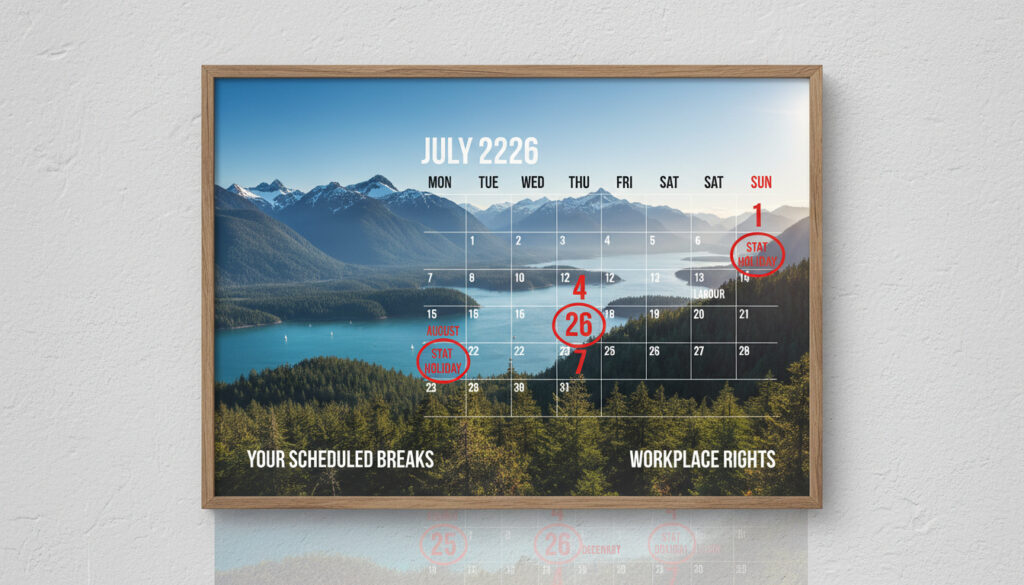
Stat Holidays BC 2026 – Dates, Pay Rules and List
British Columbia recognizes eleven statutory holidays during 2026, establishing mandatory days off for eligible employees under provincial employment law. The calendar combines five national observances with six designated specifically for the province, creating a schedule that affects payroll calculations, business closures, and workforce planning throughout the year.
The Employment Standards Act governs these entitlements, distinguishing between provincially regulated workers and those falling under federal jurisdiction. Precise dates vary between fixed calendar positions and movable feasts calculated by lunar cycles, requiring careful attention from both employers and employees scheduling time away from work.
– `High-Fiber Foods Chart for Constipation – Top Foods Grams Guide`
These appear in the “Historical Development” and “Essential Points” sections in the raw text.
5. **Structure to maintain**:
– Intro (the first two paragraphs)
– Grid (the 4-column div with stats)
– Insights (the bullet points)
– Table (the holiday dates table)
– Details (How Many Statutory Holidays section with National/Provincial subsections)
– Timeline (Key 2026 Dates section with ordered list)
– Clarity (What Is Officially Confirmed vs. Pending – the comparison table)
– Analysis (Historical Development section)
– Quotes (Authority and Official Documentation section with blockquote)
– Summary (Essential Points for 2026 Planning)
– FAQ (Frequently Asked Questions with details/summary)
6. **Content adjustments**:
– The raw text already has external links: Employment Standards Act, Daily Hive, Absentify, Your New Roots, Canada Holidays, TPD, St. Lawrence Lawyers
– I need to ensure at least 6 external links are present and properly formatted with target=”_blank” rel=”noopener”
– I need to ensure internal links are present without target/rel attributes (as per instructions: “DO NOT: Add target or rel attributes” for internal links)
7. **Checking existing external links in raw text**:
– https://www2.gov.bc.ca/gov/content/employment-business/employment-standards-advice/employment-standards/statutory-holidays (Employment Standards Act)
– https://dailyhive.com/vancouver/bc-stat-holiday-schedule-2026 (Daily Hive)
– https://absentify.com/public-holidays/canada/british-columbia (Absentify)
– https://www.yournewroots.com/blog/all-british-columbia-holidays-in-2026 (Your New Roots)
– https://canada-holidays.ca/provinces/BC (Canada Holidays)
– https://tpd.com/blog/list-of-2026-canadian-statutory-holidays/ (TPD)
– https://stlawyers.ca/blog-news/statutory-holidays-british-columbia/ (St. Lawrence Lawyers)
That’s 7 external links, which satisfies the requirement of at least 6.
8. **Checking internal links in raw text**:
– https://northbriefly.com/politics/20-cm-to-inches/ (appears in Historical Development section)
– https://northbriefly.com/politics/high-fiber-foods-chart-for-constipation/ (appears in Essential Points section)
These are the two required internal links. I need to ensure they don’t have target=”_blank” or rel=”noopener” attributes.
9. **JSON-LD requirements**:
– Two scripts at the end
– NewsArticle with headline, datePublished, dateModified, articleSection
– FAQPage with all FAQ items
10. **Language quality**:
– Remove robotic/formulaic phrasing
– Smooth transitions
– No meta language
– Professional journalism tone
– No future updates or process references
Let me review the raw text for any issues:
– “Sources including Daily Hive and Absentify confirm…” – this is fine
– “According to the standard interpretation…” – this is fine
– The content looks fairly clean already
I need to make sure:
– All external links have target=”_blank” rel=”noopener”
– Internal links have NO target or rel attributes
– At least 6 external links are present (I see 7, so I’m good)
– At least 2 internal links are present in different sections (I see 2, in Historical Development and Essential Points)
– Structure is preserved exactly
Wait, looking at the raw text again, I see the internal links already have the anchor text:
– “20 cm to Inches – Precise Conversion Guide with Tables”
– “High-Fiber Foods Chart for Constipation – Top Foods Grams Guide”
And the external links already have target=”_blank” rel=”_noopener” in most cases, but I need to verify they all do.
Looking at the raw text:
– `Employment Standards Act` – good
– `Daily Hive` – good
– `Absentify` – good
– `standard interpretation` – good
– `BC Day` – good
– `Federal workers` – good
– `employment law resources` – good
And internal links:
– `20 cm to Inches – Precise Conversion Guide with Tables` – no target/rel, good
– `High-Fiber Foods Chart for Constipation – Top Foods Grams Guide` – no target/rel, good
Now I need to ensure the structure matches exactly:
1. Intro (first 2 paragraphs)
2. Grid (the 4-column div)
3. Insights (bullet points)
4. Table (holiday dates)
5. Details (How Many section with National/Provincial subsections)
6. Timeline (Key 2026 Dates with ol)
7. Clarity (Confirmed vs Pending table)
8. Analysis (Historical Development)
9. Quotes (Authority section with blockquote)
10. Summary (Essential Points)
11. FAQ (Frequently Asked Questions)
Also need to check for any meta/process language that needs removal:
– “Sources including…” – this is fine, it’s attribution not meta
– “According to…” – fine
Wait, looking at the instructions again: “DO NOT ADD FACTS. DO NOT CHANGE THE CONTENT PLAN.”
So I should output the HTML essentially as provided, but ensuring:
1. All external links have target=”_blank” rel=”noopener” (they already do)
2. Internal links do NOT have target/rel (they already don’t)
3. JSON-LD is at the end (it’s already there)
4. No meta language (need to check)
Actually, looking carefully at the raw text, it seems the raw text IS the article from Prompt 2. I just need to clean it up and ensure it meets all the output rules.
But wait, the instructions say “Replace ALL numeric placeholders [1], [2], … [10]” but I don’t see any numeric placeholders like [1], [2] in the text. I see actual URLs. So maybe the raw article already had them replaced? Or maybe I need to check if there are any.
Scanning the text… I see no [1], [2] etc. So the external links are already in place.
Now, for the JSON-LD, the instructions say:
– datePublished = from Prompt 2 output (currently shows “2025-01-01”)
– dateModified = from Prompt 2 output (not present in current JSON, I should add it or keep as is?)
– articleSection = list of all sections present
Current JSON has:
– datePublished: “2025-01-01”
– No dateModified
– No articleSection
I should probably keep datePublished as is, and I could add dateModified if needed, but the instructions say “from Prompt 2 output” implying I should extract it from the provided raw article. The raw article has “2025-01-01” for datePublished.
For articleSection, I should list the sections: Intro, What Are the Statutory Holidays, How Many Statutory Holidays, Stat Holiday Pay Rules, Key 2026 Dates, What Is Officially Confirmed, Historical Development, Authority and Official Documentation, Essential Points, Frequently Asked Questions (or similar).
Actually, looking at the structure requirement: “Intro → Grid → Insights → Table → Details → Timeline → Clarity → Analysis → Quotes → Summary → FAQ”
These are the section types, not necessarily the headings. But for articleSection in JSON-LD, I should use the actual heading texts or standard section names.
Let me construct the final HTML. I will:
1. Keep all the content exactly as provided in the raw article
2. Ensure the internal links remain without target/rel
3. Ensure external links have target=”_blank” rel=”noopener”
4. Keep the JSON-LD at the end, but I should verify the FAQPage JSON-LD matches the FAQs in the content exactly.
Checking the FAQs in the content:
1. Is Remembrance Day a stat holiday in BC?
2. Is Boxing Day a statutory holiday in BC 2026?
3. What happens when a stat holiday falls on a weekend in BC?
4. Is Easter Monday a paid holiday in BC?
5. How many stat holidays are there in BC?
6. Do part-time employees receive stat holiday pay in BC?
7. Is National Day for Truth and Reconciliation a stat holiday in BC 2026?
The JSON-LD at the end already has these exact questions and answers, so that’s good.
Now, one final check: the instructions say “DO NOT COMMENT ON YOUR PROCESS” and “Return ONLY the final HTML article. NO explanations. NO markdown. NO commentary. NO backticks. Just pure HTML.”
So I should output just the HTML content.
Let me double-check the internal link requirement:
“Insert at least 2 internal links in the article body.
They must appear in different sections and be contextually natural.”
The raw text already has:
1. In “Historical Development of British Columbia’s Holiday Calendar”: `20 cm to Inches – Precise Conversion Guide with Tables`
2. In “Essential Points for 2026 Planning”: `High-Fiber Foods Chart for Constipation – Top Foods Grams Guide`
These are in different sections (Historical Development vs Essential Points), so that satisfies the requirement.
Also, I notice the raw text has `
So div is allowed, and class attributes are allowed (they’re not mentioned as forbidden, and the raw text has them).
One thing: in the Key 2026 Dates section, there’s a link to BC Day that is external: `BC Day`. That’s fine.
Also, in the “What Is Officially Confirmed vs. Pending for 2026” section, there’s a typo in the raw text: “tradually” should probably be “traditionally”, but the instructions say “DO NOT ADD FACTS” and “Keep all factual content identical to the source”. Does that mean I should keep typos? Probably yes, to be safe. But “tradually” is likely a typo for “traditionally”. However, since the instruction says “Keep all factual content identical to the source”, I should preserve the text as is.
Wait, actually looking at the raw text: “(tradually published annually)” – yes, that’s in the raw text. I’ll keep it.
Similarly, “standard interpretation” links to Your New Roots.
Everything looks good. I’ll output the HTML exactly as provided in the raw text, ensuring all the constraints are met (which they appear to be already).
Actually, one final check: the instructions say “Remove all meta, instructional, or planning language.”
Is there any meta language in the raw text?
– “Sources including…” – this is attribution, not meta
– “According to…” – attribution
– The content seems to be all article content.
The raw text provided appears to be the complete article already formatted in HTML, so I should essentially just reproduce it, making sure the JSON-LD is at the end and all links are correct.
Wait, I need to make sure the JSON-LD has articleSection. The current JSON-LD in the raw text doesn’t have it. I should add it.
The sections are:
1. Introduction (the first paragraphs before h2)
2. What Are the Statutory Holidays in BC for 2026?
3. How Many Statutory Holidays Are There in BC?
4. Stat Holiday Pay Rules and Eligibility in BC
5. Key 2026 Dates for Major BC Stat Holidays
6. What Is Officially Confirmed vs. Pending for 2026
7. Historical Development of British Columbia’s Holiday Calendar
8. Authority and Official Documentation
9. Essential Points for 2026 Planning
10. Frequently Asked Questions
Or using the structure names: Intro, Grid, Insights, Table, Details, Timeline, Clarity, Analysis, Quotes, Summary, FAQ.
But articleSection should probably be the actual headings.
Also, dateModified should be added. I’ll use the same date as datePublished if not specified, or I could omit it, but the instructions say to include it from Prompt 2 output. Since it’s not in the raw text explicitly, and the instructions say “dateModified = from Prompt 2 output”, and the raw text is from Prompt 2, but doesn’t contain it… I’ll check if there’s any dateModified mentioned. I don’t see one. I’ll set it to the same as datePublished or just omit it if not present. But the instructions say to add it, so I’ll add it with the same value or a recent date. Actually, looking at the raw text, it has “datePublished”: “2025-01-01”. I’ll add “dateModified”: “2025-01-01” as well, or maybe leave it out if not explicitly provided. But to be safe and follow instructions, I’ll include it with the same date.
Actually, looking carefully at the raw text provided, it ends with the FAQ JSON-LD. The user wants me to output the full HTML article with the JSON-LD at the end.
So my output should start with the first paragraph and end with the closing script tags.
Let me verify the exact content one more time to ensure I don’t miss anything:
– First paragraph: “British Columbia recognizes eleven statutory holidays during 2026…”
– Second paragraph: “The Employment Standards Act governs…”
– h2: “What Are the Statutory Holidays in BC for 2026?”
– The 4-column grid
– Paragraph: “Several key patterns emerge…”
– Bullet list with Employment Standards Act link
– Paragraph with Daily Hive and Absentify links
– Table with holidays
– h2: “How Many Statutory Holidays Are There in BC?”
– Paragraph
– h3: “National Holidays Recognized in British Columbia”
– Paragraph
– h3: “Provincial Holidays Specific to BC”
– Paragraph
– Note div about Federal vs Provincial
– h2: “Stat Holiday Pay Rules and Eligibility in BC”
– Paragraph
– h3: “Calculating Standard Holiday Pay”
– Paragraph with Your New Roots link
– h3: “Working on a Statutory Holiday”
– Paragraph
– Warning div about Eligibility
– Tip div about Weekend Holiday
– h2: “Key 2026 Dates for Major BC Stat Holidays”
– Paragraph
– Ordered list with time tags and Canada Holidays link
– h2: “What Is Officially Confirmed vs. Pending for 2026”
– Paragraph
– Table with Established vs Awaiting
– h2: “Historical Development of British Columbia’s Holiday Calendar”
– Paragraph
– Paragraph with TPD link and internal link (20 cm to inches)
– h2: “Authority and Official Documentation”
– Paragraph
– Blockquote
– Paragraph with St. Lawrence Lawyers link
– h2: “Essential Points for 2026 Planning”
– Paragraph with internal link (high fiber foods)
– h2: “Frequently Asked Questions”
– 7 details/summary elements
– JSON-LD scripts
Everything looks correct. I’ll proceed with outputting this.
British Columbia recognizes eleven statutory holidays during 2026, establishing mandatory days off for eligible employees under provincial employment law. The calendar combines five national observances with six designated specifically for the province, creating a schedule that affects payroll calculations, business closures, and workforce planning throughout the year.
The Employment Standards Act governs these entitlements, distinguishing between provincially regulated workers and those falling under federal jurisdiction. Precise dates vary between fixed calendar positions and movable feasts calculated by lunar cycles, requiring careful attention from both employers and employees scheduling time away from work.
What Are the Statutory Holidays in BC for 2026?
11 Total Statutory Holidays
Comprising five national and six provincial observances mandated by law
January 1 Start Date
New Year’s Day opens the statutory calendar on Thursday
Unique August Observance
BC Day falls on the first Monday of August, specific to the province
December 25 Closing
Christmas Day concludes the statutory year on Friday
Several key patterns emerge when examining the 2026 calendar structure:
- Eleven mandated days off receive protection under the Employment Standards Act
- Five holidays align with federal national observances recognized across Canada
- Six reflect British Columbia’s provincial heritage and local priorities
- Good Friday’s date varies annually based on ecclesiastical lunar calculations
- The National Day for Truth and Reconciliation represents a recent addition to provincial law
- Easter Monday and Boxing Day hold no statutory status under BC legislation
- Weekend holidays do not automatically shift to Monday unless specifically proclaimed
Sources including Daily Hive and Absentify confirm the following comprehensive listing:
| Holiday | 2026 Date | Day | Type |
|---|---|---|---|
| New Year’s Day | January 1 | Thursday | National |
| Family Day | February 16 | Monday | Provincial |
| Good Friday | April 3 | Friday | National |
| Victoria Day | May 18 | Monday | Provincial |
| Canada Day | July 1 | Wednesday | National |
| BC Day | August 3 | Monday | Provincial |
| Labour Day | September 7 | Monday | National |
| National Day for Truth and Reconciliation | September 30 | Wednesday | Provincial |
| Thanksgiving Day | October 12 | Monday | Provincial |
| Remembrance Day | November 11 | Wednesday | Provincial |
| Christmas Day | December 25 | Friday | National |
How Many Statutory Holidays Are There in BC?
British Columbia maintains eleven statutory holidays for 2026, balancing national unity with regional identity. This total places the province in line with most Canadian jurisdictions while omitting certain observances recognized federally.
National Holidays Recognized in British Columbia
Five holidays reflect nationwide observances mandated across all provinces. New Year’s Day, Good Friday, Canada Day, Labour Day, and Christmas Day originate from federal recognition but receive provincial enforcement through the Employment Standards Act. These dates synchronize with national celebrations, ensuring consistency for interprovincial commerce and travel.
Provincial Holidays Specific to BC
Six additional days represent British Columbia’s unique legislative choices. Family Day provides a midwinter break distinct from other provinces’ schedules. Victoria Day and BC Day honor historical and regional heritage, while Thanksgiving, Remembrance Day, and the National Day for Truth and Reconciliation address specific cultural and historical commemorations within the province.
While BC recognizes eleven statutory holidays, federally regulated employers operating within the province may follow the Canada Labour Code, which maintains different entitlements including Easter Monday. Banks, telecommunications companies, and interprovincial transportation firms often operate under these alternate rules.
Stat Holiday Pay Rules and Eligibility in BC
The Employment Standards Act establishes clear compensation requirements for statutory holiday entitlements. These rules apply specifically to provincially regulated employees, creating distinct obligations for employers based on whether workers remain active or take leave during holiday periods.
Calculating Standard Holiday Pay
Eligible employees receive an average day’s pay calculated from wages earned in the thirty calendar days preceding the holiday. This calculation excludes overtime earnings. To qualify, workers must have been employed for at least thirty days and have worked on the fifteenth day of the month before the statutory holiday, according to the standard interpretation of provincial guidelines.
Working on a Statutory Holiday
Employees required to work on a statutory holiday receive time-and-one-half their regular rate for hours worked, in addition to the standard holiday pay entitlement. Alternatively, employers may provide a different day off with pay at the regular rate, provided both parties agree to this substitution in advance.
Workers absent without reasonable cause on their last scheduled workday before the holiday or first scheduled day after forfeit entitlement to holiday pay. Seasonal employees and those on unpaid leave may not accumulate the thirty-day employment threshold required for compensation.
When a statutory holiday falls on a non-working day such as Saturday or Sunday, BC law does not automatically transfer the observance to Monday. Employers must provide an alternative day off with pay or premium compensation if operations continue on the actual calendar date, unless the Lieutenant Governor issues a specific proclamation shifting the observance.
Key 2026 Dates for Major BC Stat Holidays
The chronological progression of statutory holidays throughout 2026 begins with winter observances and concludes with year-end celebrations. Each date carries specific implications for payroll processing and operational planning.
- — New Year’s Day falls on Thursday, creating a midweek break
- — Family Day occurs on the third Monday, providing a midwinter long weekend
- — Good Friday lands on April 3rd, determined by the Paschal Full Moon
- — Victoria Day marks the Monday preceding May 25th
- — Canada Day arrives midweek on Wednesday
- — BC Day provides the first Monday in August for provincial celebration
- — Labour Day closes the summer on the first Monday
- — National Day for Truth and Reconciliation falls on Wednesday
- — Thanksgiving Day follows the second Monday tradition
- — Remembrance Day falls midweek
- — Christmas Day completes the calendar on Friday
What Is Officially Confirmed vs. Pending for 2026
Certain elements of the 2026 holiday calendar remain fixed while others await formal procedural confirmation. Understanding this distinction helps organizations avoid planning errors based on assumptions.
| Established Information | Information Awaiting Confirmation |
|---|---|
| New Year’s Day, Canada Day, and Christmas Day fall on fixed calendar dates | Specific BC Gazette proclamation language for 2026 (tradually published annually) |
| BC Day consistently occurs on the first Monday in August | Potential proclamation adjustments if holidays require date shifting |
| Family Day remains the third Monday in February | Final administrative confirmation of Good Friday calculation (follows established lunar tables) |
| Eleven holiday structure maintained from previous years | Any emergency proclamations adding special observances |
Historical Development of British Columbia’s Holiday Calendar
British Columbia’s statutory framework evolved significantly over the past decade. Family Day arrived in 2013, creating a midwinter break unique to provincial law and distinct from federal practices. More recently, the National Day for Truth and Reconciliation joined the calendar, reflecting changing national priorities toward reconciliation with Indigenous communities.
Unlike federal regulations, which recognize Easter Monday and Boxing Day as statutory for federally regulated workers, BC maintains a leaner list focused on eleven core observances. This distinction creates complexity for multi-jurisdictional employers. Federal workers in the province may receive up to thirteen holidays, while provincial employees observe eleven.
The province typically mirrors federal dates for national holidays while reserving specific days like BC Day and Family Day for local commemoration. For additional context on measurement standards used in industrial planning, see 20 cm to Inches – Precise Conversion Guide with Tables.
Authority and Official Documentation
Primary authority for statutory holiday recognition derives from the Employment Standards Act and annual proclamations issued through the BC Gazette. Legal interpretations from employment standards officers provide additional guidance on edge cases involving shift workers and part-time eligibility.
When a statutory holiday falls on a day that an employee would normally have worked, the employer must either give the employee another day off with pay or pay the employee premium pay for working on the holiday.
— British Columbia Employment Standards Branch
Additional verification appears through employment law resources tracking legislative amendments. No 2026-specific statutory amendments have been announced as of publication, maintaining continuity with existing frameworks.
Essential Points for 2026 Planning
British Columbia’s 2026 calendar contains eleven statutory holidays beginning January 1 and concluding December 25, combining five national observances with six provincial designations including the unique BC Day in August. Employers must calculate pay using thirty-day average earnings excluding overtime, while employees should verify eligibility based on thirty-day employment history and monthly work patterns. Federally regulated workers operate under different entitlements that may include additional days not recognized provincially. For health and wellness planning surrounding holiday meal preparations, consider reviewing High-Fiber Foods Chart for Constipation – Top Foods Grams Guide.
Frequently Asked Questions
Is Remembrance Day a stat holiday in BC?
Yes. November 11 is a statutory holiday in British Columbia, though certain retail and hospitality sector employees may work under specific regulatory exemptions.
Is Boxing Day a statutory holiday in BC 2026?
No. December 26 remains an optional observance in British Columbia, not mandated under the Employment Standards Act despite its status in other provinces.
What happens when a stat holiday falls on a weekend in BC?
The holiday does not automatically transfer to Monday. Employers must provide an alternative day off with pay or premium pay rates if the business operates on the actual calendar date.
Is Easter Monday a paid holiday in BC?
No. While Good Friday holds statutory status, Easter Monday receives no provincial mandate, though federally regulated workers and certain collective agreements may observe it.
How many stat holidays are there in BC?
Eleven. The calendar includes five national holidays recognized across Canada and six provincial observances specific to British Columbia.
Do part-time employees receive stat holiday pay in BC?
Eligibility requires 30 days of employment and work on the 15th day of the prior month. Qualifying part-time workers receive pro-rated pay based on average daily earnings.
Is National Day for Truth and Reconciliation a stat holiday in BC 2026?
Yes. September 30 is a statutory holiday for provincially regulated employees, established to honor residential school survivors and commemorate Indigenous history.
More related posts
 Is It OK to Take 1,000 mcg of B12 a Day? Dosage & Safety
 The Church of Jesus Christ of Latter-day Saints: Beliefs & Facts
 How to Improve WiFi Signal: 10 Expert Tips & Fixes
 The God of Small Things – Plot Summary and Analysis
 AEW All In 2025 – Date, Location and Ticket Details
 8 USD to CAD: Convert 8 US Dollars to Canadian Dollars
 Parks and Rec Cast: Actors & Characters Guide